<antirez>

On Redis master-slave terminology

▼
antirez 2993 days ago.
Today it happened again. A developer, that we’ll call Mark to avoid exposing his real name, read the Redis 5.0 RC5 change log, and was disappointed to see that Redis still uses the “master” and “slave” terminology in order to identify different roles in Redis replication.

I said that I was sorry he was disappointed about that, but at the same time, I don’t believe that terminology out of context is offensive, so if I use master-slave in the context of databases, and I’m not referring in any way to slavery. I originally copied the terms from MySQL, and now they are the way we call things in Redis, and since I do not believe in this battle (I’ll tell you later why), to change the documentation, deprecate the API and add a new one, change the INFO fields, just to make a subset of people that care about those things more happy, do not make sense to me.
Redis is not "open core"

▼
antirez 3006 days ago.
Human beings have a strong tendency to put new facts into pre-existing categories. This is useful to mentally and culturally classify similar events under the same logical umbrella, so when two days ago I clarified that the Redis core was still released under the vanilla BSD license, and only certain Redis modules developed by Redis Labs were going to change license, from AGPL to a different non open source license, people said “Ah! Ok you are going open core”.

The simplification this time does not work if it is in your interest to capture the truth of what is happening here. An open core technology requires two things. One is that the system is modular, and the other is that parts of such system are made proprietary in order to create a product around an otherwise free software. For example providing a single node of a database into the open source, and then having the clustering logic and mechanism implemented in a different non-free layer, is an open core technology. Similarly is open core if I write a relational database with a modular storage system, but the only storage that is able to provide strong guarantees is non free. In an open core business model around an open source system it is *fundamental* that you take something useful out of the free software part.

Redis will remain BSD licensed

▼
antirez 3009 days ago.
Today a page about the new Common Clause license in the Redis Labs web site was interpreted as if Redis itself switched license. This is not the case, Redis is, and will remain, BSD licensed. However in the era of [edit] uncontrollable spreading of information, my attempts to provide the correct information failed, and I’m still seeing everywhere “Redis is no longer open source”. The reality is that Redis remains BSD, and actually Redis Labs did the right thing supporting my effort to keep the Redis core open as usually.

Redis Lua scripting: several security vulnerabilities fixed

▼
antirez 3079 days ago.
A bit more than one month ago I received an email from the Apple Information Security team. During an auditing the Apple team found a security issue in the Redis Lua subsystem, specifically in the cmsgpack library. The library is not part of Lua itself, it is an implementation of MessagePack I wrote myself. In the course of merging a pull request improving the feature set, a security issue was added. Later the same team found a new issue in the Lua struct library, again such library was not part of Lua itself, at least in the release of Lua we use: we just embedded the source code inside our Lua implementation in order to provide some functionality to the Lua interpreter that is available to Redis users. Then I found another issue in the same struct package, and later the Alibaba team found many other issues in cmsgpack and other code paths using the Lua API. In a short amount of time I was sitting on a pile of Lua related vulnerabilities.

Clarifications on the Incapsula Redis security report

▼
antirez 3090 days ago.
A few days ago I started my day with my Twitter feed full of articles saying something like: “75% of Redis servers infected by malware”. The obvious misquote referred to a research by Incapsula where they found that 75% of the Redis instances left open on the internet, without any protection, on a public IP address, are infected [1].

[1] https://www.incapsula.com/blog/report-75-of-open-redis-servers-are-infected.html

Many folks don’t need any clarification about all this, because if you have some grip on computer security and how Redis works, you can contextualize all this without much efforts. However I’m writing this blog post for two reasons. The obvious one is that it can help the press and other users that are not much into security and/or Redis to understand what’s going on. The second is that the exposed Redis instances are a case study about safe defaults that should be interesting for the security circles.

A short tale of a read overflow

▼
antirez 3204 days ago.
[This blog post is also experimentally available on Medium: https://medium.com/antirez/a-short-tale-of-a-read-overflow-b9210d339cff]

When a long running process crashes, it is pretty uncool. More so if the process happens to take a lot of state in memory. This is why I love web programming frameworks that are able, without major performance overhead, to create a new interpreter and a new state for each page view, and deallocate every resource used at the end of the page generation. It is an inherently more reliable programming paradigm, where memory leaks, descriptor leaks, and even random crashes from time to time do not constitute a serious issue. However system software like Redis is at the other side of the spectrum, a side populated by things that should never crash.

An update on Redis Streams development

▼
antirez 3218 days ago.
I saw multiple users asking me what is happening with Streams, when they’ll be ready for production uses, and in general what’s the ETA and the plan of the feature. This post will attempt to clarify a bit what comes next.

To start, in this moment Streams are my main priority: I want to finish this work that I believe is very useful in the Redis community and immediately start with the Redis Cluster improvements plans. Actually the work on Cluster has already started, with my colleague Fabio Nicotra that is porting redis-trib, the Cluster management tool, inside the old and good redis-cli. This step involves translating the code from Ruby to C. In the meantime, a few weeks ago I finished writing the Streams core, and I deleted the “streams” feature branch, merging everything into the “unstable” branch.

Redis PSYNC2 bug post mortem

▼
antirez 3272 days ago.
Four days ago a user posted a critical issue in the Redis Github repository. The problem was related to the new Redis 4.0 PSYNC2 replication protocol, and was very critical. PSYNC2 brings a number of good things to Redis replication, including the ability to resynchronize just exchanging the differences, and not the whole data set, after a failover, and even after a slave controlled restart. The problem was about this latter feature: with PSYNC2 the RDB file is augmented with replication information. After a slave is restarted, the replication metadata is loaded back, and the slave is able to perform a PSYNC attempt, trying to handshake with the master and receive the differences since the last disconnection.

Streams: a new general purpose data structure in Redis.

▼
antirez 3333 days ago.
Until a few months ago, for me streams were no more than an interesting and relatively straightforward concept in the context of messaging. After Kafka popularized the concept, I mostly investigated their usefulness in the case of Disque, a message queue that is now headed to be translated into a Redis 4.2 module. Later I decided that Disque was all about AP messaging, which is, fault tolerance and guarantees of delivery without much efforts from the client, so I decided that the concept of streams was not a good match in that case.

Doing the FizzleFade effect using a Feistel network

▼
antirez 3367 days ago.
Today I read an interesting article about how the Wolfenstein 3D game implemented a fade effect using a Linear Feedback Shift Register. Every pixel of the screen is set red in a pseudo random way, till all the screen turns red (or other colors depending on the event happening in the game). The blog post describing the implementation is here and is a nice read: http://fabiensanglard.net/fizzlefade/index.php

You  may wonder why the original code used a LFSR or why I'm proposing a different approach, instead of the vanilla setPixel(rand(),rand()): doing this with a pseudo random generator, as noted in the blog post, is slow, but is also visually very unpleasant, since the more red pixels you have on the screen already, the less likely is that you hit a new yet-not-red pixel, so the final pixels take forever to turn red (I *bet* that many readers of this blog post tried it in the old times of the Spectum, C64, or later with QBASIC or GWBasic). In the final part of the blog post the author writes:

The mythical 10x programmer

▼
antirez 3549 days ago.
A 10x programmer is, in the mythology of programming, a programmer that can do ten times the work of another normal programmer, where for normal programmer we can imagine one good at doing its work, but without the magical abilities of the 10x programmer. Actually to better characterize the “normal programmer” it is better to say that it represents the one having the average programming output, among the programmers that are professionals in this discipline.

The programming community is extremely polarized about the existence or not of such a beast: who says there is no such a thing as the 10x programmer, who says it actually does not just exist, but there are even 100x programmers if you know where to look for.

Redis on the Raspberry Pi: adventures in unaligned lands

▼
antirez 3553 days ago.
After 10 million of units sold, and practically an endless set of different applications and auxiliary devices, like sensors and displays, I think it’s deserved to say that the Raspberry Pi is not just a success, it also became one of the preferred platforms for programmers to experiment in the embedded space. Probably with things like the Pi zero, it is also becoming the platform in order to create hardware products, without incurring all the risks and costs of designing, building, and writing software for vertical devices.

The first release candidate of Redis 4.0 is out

▼
antirez 3637 days ago.
It’s not yet stable but it’s soon to become, and comes with a long list of things that will make Redis more useful for we users: finally Redis 4.0 Release Candidate 1 is here, and is bold enough to call itself 4.0 instead of 3.4. For me semantic versioning is not a thing, what I like instead is try to communicate, using version numbers and jumps, what’s up with the new version, and in this specific case 4.0 means “this is the shit”.

It’s just that Redis 4.0 has a lot of things that Redis should have had since ages, in a different world where one developer can, like Ken The Warrior, duplicate itself in ten copies and start to code. But it does not matter how hard I try to learn about new vim shortcuts, still the duplicate-me thing is not in my chords.

Random notes on improving the Redis LRU algorithm

▼
antirez 3763 days ago.
Redis is often used for caching, in a setup where a fixed maximum memory to use is specified. When new data arrives, we need to make space by removing old data. The efficiency of Redis as a cache is related to how good decisions it makes about what data to evict: deleting data that is going to be needed soon is a poor strategy, while deleting data that is unlikely to be requested again is a good one.

In other terms every cache has an hits/misses ratio, which is, in qualitative terms, just the percentage of read queries that the cache is able to serve. Accesses to the keys of a cache are not distributed evenly among the data set in most workloads. Often a small percentage of keys get a very large percentage of all the accesses. Moreover the access pattern often changes over time, which means that as time passes certain keys that were very requested may no longer be accessed often, and conversely, keys that once were not popular may turn into the most accessed keys.

Writing an editor in less than 1000 lines of code, just for fun

▼
antirez 3782 days ago.
WARNING: Long pretty useless blog post. TLDR is that I wrote, just for fun, a text editor in less than 1000 lines of code that does not depend on ncurses and has support for syntax highlight and search feature. The code is here: http://github.com/antirez/kilo.

Screencast here: https://asciinema.org/a/90r2i9bq8po03nazhqtsifksb

For the sentimentalists, keep reading…

A couple weeks ago there was this news about the Nano editor no longer being part of the GNU project. My first reaction was, wow people still really care about an old editor which is a clone of an editor originally part of a terminal based EMAIL CLIENT. Let’s say this again, “email client”. The notion of email client itself is gone at this point, everything changed. And yet I read, on Hacker News, a number of people writing how they were often saved by the availability of nano on random systems, doing system administrator tasks, for example. Nano is also how my son wrote his first program in C. It’s an acceptable experience that does not require past experience editing files.

Programmers are not different, they need simple UIs.

▼
antirez 3829 days ago.
I’m spending days trying to get a couple of APIs right. New APIs about modules, and a new Redis data type.
I really mean it when I say *days*, just for the API. Writing drafts, starting the implementation shaping data structures and calls, and then restarting from scratch to iterate again in a better way, to improve the design and the user facing part.

Why I do that, delaying features for weeks? Is it really so important?
Programmers are engineers, maybe they should just adapt to whatever API is better to export for the system exporting it.

Redis Loadable Modules System

▼
antirez 3843 days ago.
It was a matter of time but it eventually happened. In the Redis 1.0 release notes, 7 years ago, I mentioned that one of the interesting features for the future was “loadable modules”. I was really interested in such a feature back then, but over the years I became more and more skeptic about the idea of adding loadable modules in Redis. And probably for good reasons.

Modules can be the most interesting feature of a system and the most problematic one at the same
time: API incompatibilities between versions, low quality modules crashing the system, a lack

Three ideas about text messages

▼
antirez 3846 days ago.
I’m aboard of a flight bringing me to San Francisco. Eventually I purchased the slowest internet connection of my life (well at least for a good reason), but for several hours I was without internet, as usually when I fly.

I don’t mind staying disconnected for some time usually. It’s a good time to focus, write some code, or a blog post like this one. However when I’m disconnected, what makes the most difference is not Facebook or Twitter or Github, but the lack of text messages.

At this point text messages are a fundamental thing in my life. They are also probably the main source of distraction. I use messages to talk with my family, even just to communicate between different floors. I use messages with friends to organize dinners and vacations. I even use messages with the plumber or the doctor.

Redis 3.2.0 is out!

▼
antirez 3847 days ago.
It took more than expected, but finally we have it, Redis 3.2.0 stable is out with changes that may be useful to a big number of Redis users. At this point I covered the changes multiple time, but the big ones are:

* The GEO API. Index whatever you want by latitude and longitude, and query by radius, with the same speed and easy of use of the other Redis data structures. Here you can find the API documentation: http://redis.io/commands/#geo. Thank you to Matt Stancliff for the initial implementation, that was reworked but is still at the core of the GEO API, and to the developers of ARDB for providing the geo indexing code that Matt used.

100 more of those BITFIELDs

▼
antirez 3917 days ago.
Today Redis is 7 years old, so to commemorate the event a bit I passed the latest couple of days doing a fun coding marathon to implement a new crazy command called BITFIELD.

The essence of this command is not new, it was proposed in the past by me and others, but never in a serious way, the idea always looked a bit strange. We already have bit operations in Redis: certain users love it, it’s a good way to represent a lot of data in a compact way. However so far we handle each bit separately, setting, testing, getting bits, counting all the bits that are set in a range, and so forth.

The binary search of distributed programming

▼
antirez 3930 days ago.
Yesterday night I was re-reading Redlock analysis Martin Kleppmann wrote (http://martin.kleppmann.com/2016/02/08/how-to-do-distributed-locking.html). At some point Martin wonders if there is some good way to generate monotonically increasing IDs with Redis.

This apparently simple problem can be more complex than it looks at a first glance, considering that it must ensure that, in all the conditions, there is a safety property which is always guaranteed: the ID generated is always greater than all the past IDs generated, and the same ID cannot be generated multiple times. This must hold during network partitions and other failures. The system may just become unavailable if there are less than the majority of nodes that can be reached, but never provide the wrong answer (note: as we'll see this algorithm has another liveness issue that happens during high load of requests).

Is Redlock safe?

▼
antirez 3934 days ago.
Martin Kleppmann, a distributed systems researcher, yesterday published an analysis of Redlock (http://redis.io/topics/distlock), that you can find here: http://martin.kleppmann.com/2016/02/08/how-to-do-distributed-locking.html

Redlock is a client side distributed locking algorithm I designed to be used with Redis, but the algorithm orchestrates, client side, a set of nodes that implement a data store with certain capabilities, in order to create a multi-master fault tolerant, and hopefully safe, distributed lock with auto release capabilities.

Disque 1.0 RC1 is out!

▼
antirez 3972 days ago.
Today I’m happy to announce that the first release candidate for Disque 1.0 is available.

If you don't know what Disque is, the best starting point is to read the README in the Github project page at http://github.com/antirez/disque.

Disque is a just piece of software, so it has a material value which can be zero or more, depending on its ability to make useful things for people using it. But for me there is an huge value that goes over what Disque, materially, is. It is the value of designing and doing something you care about. It’s the magic of programming: where there was nothing, now there is something that works, that other people may potentially analyze, run, use.

Generating unique IDs: an easy and reliable way

▼
antirez 4014 days ago.
Two days ago Mike Malone published an interesting post on Medium about the V8 implementation of Math.random(), and how weak is the quality of the PRNG used: http://bit.ly/1SPDraN.

The post was one of the top news on Hacker News today. It’s pretty clear and informative from the point of view of how Math.random() is broken and how should be fixed, so I’ve nothing to add to the matter itself. But since the author discovered the weakness of the PRNG in the context of generating large probably-non-colliding IDs, I want to share with you an alternative that I used multiple times in the past, which is fast and extremely reliable.

6 years of commit visualized

▼
antirez 4015 days ago.
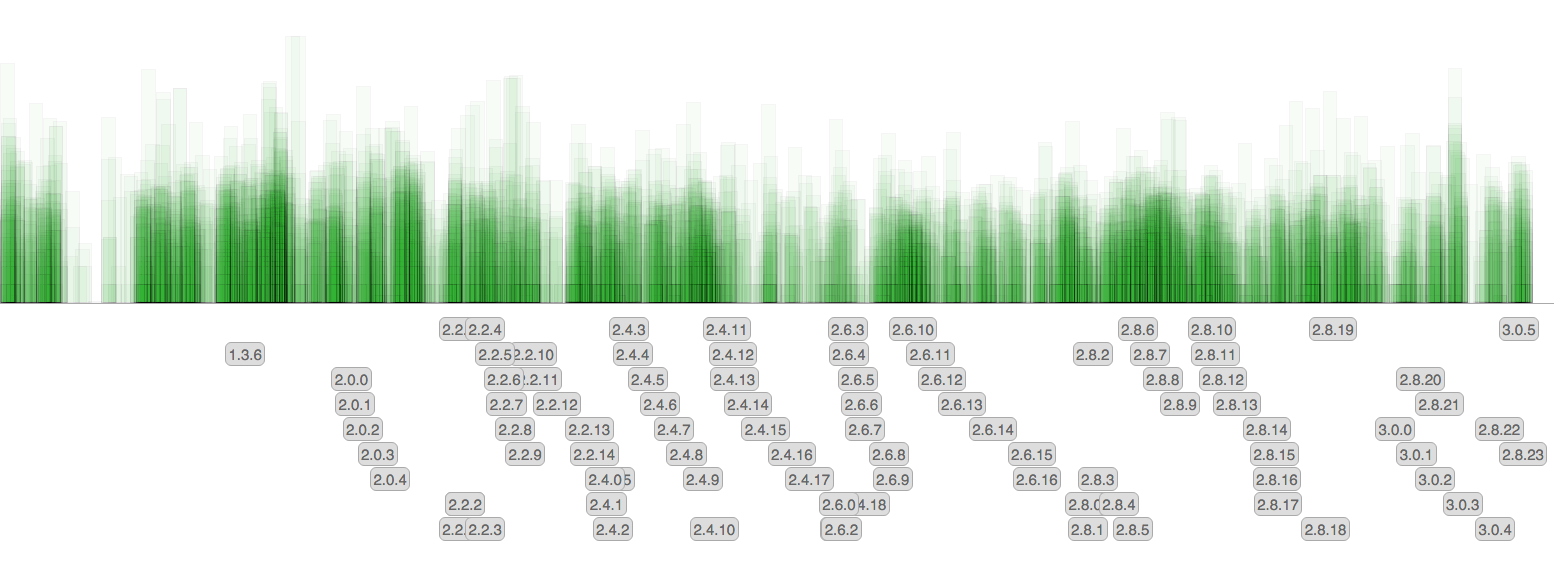
Today I was curious about plotting all the Redis commits we have on Git, which are 90% of all the Redis commits. There was just an initial period where I used SVN but switched very soon.

Full size image here: http://antirez.com/misc/commitsvis.png


Each commit is a rectangle. The height is the number of affected lines (a logarithmic scale is used). The gray labels show release tags.

There are little surprises since the amount of commit remained pretty much the same over the time, however now that we no longer backport features back into 3.0 and future releases, the rate at which new patchlevel versions are released diminished.

Recent improvements to Redis Lua scripting

▼
antirez 4016 days ago.
Lua scripting is probably the most successful Redis feature, among the ones introduced when Redis was already pretty popular: no surprise that a few of the things users really want are about scripting. The following two features were suggested multiple times over the last two years, and many people tried to focus my attention into one or the other during the Redis developers meeting, a few weeks ago.

1. A proper debugger for Redis Lua scripts.
2. Replication, and storage on the AOF, of Lua scripts as a set of write commands materializing the *effects* of the script, instead of replicating the script itself as we normally do.

A few things about Redis security

▼
antirez 4032 days ago.
IMPORTANT EDIT: Redis 3.2 security improved by implementing protected mode. You can find the details about it here: https://www.reddit.com/r/redis/comments/3zv85m/new_security_feature_redis_protected_mode/

From time to time I get security reports about Redis. It’s good to get reports, but it’s odd that what I get is usually about things like Lua sandbox escaping, insecure temporary file creation, and similar issues, in a software which is designed (as we explain in our security page here http://redis.io/topics/security) to be totally insecure if exposed to the outside world.

Moving the Redis community on Reddit

▼
antirez 4044 days ago.
I’m just back from the Redis Dev meeting 2015. We spent two incredible days talking about Redis internals in many different ways. However while I’m waiting to receive private notes from other attenders, in order to summarize in a blog post what happened and what were the most important ideas exposed during the meetings, I’m going to touch a different topic here. I took the non trivial decision to move the Redis mailing list, consisting of 6700 members, to Reddit.

This looks like a crazy ideas probably in some way, and “to move” is probably not the right verb, since the ML will still exist. However it will only be used in order to receive announcements of new releases, critical informations like security related ones, and from time to time, links to very important discussions that are happening on Reddit.

Clarifications about Redis and Memcached

▼
antirez 4070 days ago.
If you know me, you know I’m not the kind of guy that considers competing products a bad thing. I actually love the users to have choices, so I rarely do anything like comparing Redis with other technologies.
However it is also true that in order to pick the right solution users must be correctly informed.

This post was triggered by reading a blog post published by Mike Perham, that you may know as the author of a popular library called Sidekiq, that happens to use Redis as backend. So I would not consider Mike a person which is “against” Redis at all. Yet in his blog post that you can find at the URL http://www.mikeperham.com/2015/09/24/storing-data-with-redis/ he states that, for caching, “you should probably use Memcached instead [of Redis]”. So Mike simply really believes Redis is not good for caching, and he arguments his thesis in this way:

Lazy Redis is better Redis

▼
antirez 4070 days ago.
Everybody knows Redis is single threaded. The best informed ones will tell you that, actually, Redis is *kinda* single threaded, since there are threads in order to perform certain slow operations on disk. So far threaded operations were so focused on I/O that our small library to perform asynchronous tasks on a different thread was called bio.c: Background I/O, basically.

However some time ago I opened an issue where I promised a new Redis feature that many wanted, me included, called “lazy free”. The original issue is here: https://github.com/antirez/redis/issues/1748.

About Redis Sets memory efficiency

▼
antirez 4099 days ago.
Yesterday Amplitude published an article about scaling analytics, in the context of using the Set data type. The blog post is here: https://amplitude.com/blog/2015/08/25/scaling-analytics-at-amplitude/

On Hacker News people asked why not using Redis instead: https://news.ycombinator.com/item?id=10118413 

Amplitude developers have their set of reasons for not using Redis, and in general if you have a very specific problem and want to scale it in the best possible way, it makes sense to implement your vertical solution. I’m not adverse to reinventing the wheel, you want your very specific wheel sometimes, that a general purpose system may not be able to provide. Moreover creating your solution gives you control on what you did, boosts your creativity and your confidence in what you, as a developer can do, makes you able to debug whatever bug may arise in the future without external help.

Thanks Pivotal, Hello Redis Labs

▼
antirez 4143 days ago.
I consider myself very lucky for contributing to the open source. For me OSS software is not just a license: it means transparency in the development process, choices that are only taken in order to improve software from the point of view of the users, documentation that attempts to cover everything, and simple, understandable systems. The Redis community had the privilege of finding in Pivotal, and VMware before, a company that thinks at open source in the same way as we, the community of developers, think of it.

Commit messages are not titles

▼
antirez 4165 days ago.
Nor subjects, for what matters. Everybody will tell you to don't add a dot at the end of the first line of a commit message. I followed the advice for some time, but I'll stop today, because I don't believe commit messages are titles or subjects. They are synopsis of the meaning of the change operated by the commit, so they are small sentences. The sentence can be later augmented with more details in the next lines of the commit message, however many times there is *no* body, there is just the first line. How many emails or articles you see with just the subject or the title? Very little, I guess. So for me it is like:

Plans for Redis 3.2

▼
antirez 4176 days ago.
I’m back from Paris, DotScale 2015 was a very interesting conference. Before leaving I was working on Sentinel in the context of the unstable branch: the work was mainly about connection sharing. In short, it is the ability of a few Sentinels to scale, monitoring many masters. Before to leave, and now that I’m back, I tried to “secure” a set of features that will be the basis for Redis 3.2. In the next weeks I’ll be focusing developing these features, so I thought it’s worth to share the list with you ASAP.

Adventures in message queues

▼
antirez 4264 days ago.
EDIT: In case you missed it, Disque source code is now available at http://github.com/antirez/disque

It is a few months that I spend ~ 15-20% of my time, mostly hours stolen to nights and weekends, working to a new system. It’s a message broker and it’s called Disque. I’ve an implementation of 80% of what was in the original specification, but still I don’t feel like it’s ready to be released. Since I can’t ship, I’ll at least blog… so that’s the story of how it started and a few details about what it is.

Redis Conference 2015

▼
antirez 4270 days ago.
I’m back home, after a non easy trip, since to travel from San Francisco to Sicily is kinda NP complete: there are no solutions involving less than three flights. However it was definitely worth it, because the Redis Conference 2015 was very good, SF was wonderful as usually and I was able to meet with many interesting people. Here I’ll limit myself to writing a short account of the conference, but the trip was also an incredible experience because I discovered old and new friends, that are not just smart programmers, but also people I could imagine being my friends here in Sicily. I never felt alone while I was 10k kilometers away from my home.

Side projects

▼
antirez 4282 days ago.
Today Redis is six years old. This is an incredible accomplishment for me, because in the past I switched to the next thing much faster. There are things that lasted six years in my past, but not like Redis, where after so much time, I still focus most of my everyday energies into.

How did I stopped doing new things to focus into an unique effort, drastically monopolizing my professional life? It was a too big sacrifice to do, for an human being with a limited life span. Fortunately I simply never did this, I never stopped doing new things.

Why we don’t have benchmarks comparing Redis with other DBs

▼
antirez 4310 days ago.
Redis speed could be one selling point for new users, so following the trend of comparative “advertising” it should be logical to have a few comparisons at Redis.io. However there are two problems with this. One is of goals: I don’t want to convince developers to adopt Redis, we just do our best in order to provide a suitable product, and we are happy if people can get work done with it, that’s where my marketing wishes end. There is more: it is almost always impossible to compare different systems in a fair way.

Redis latency spikes and the Linux kernel: a few more details

▼
antirez 4397 days ago.
Today I was testing Redis latency using m3.medium EC2 instances. I was able to replicate the usual latency spikes during BGSAVE, when the process forks, and the child starts saving the dataset on disk. However something was not as expected. The spike did not happened because of disk I/O, nor during the fork() call itself.

The test was performed with a 1GB of data in memory, with 150k writes per second originating from a different EC2 instance, targeting 5 million keys (evenly distributed). The pipeline was set to 4 commands. This translates to the following command line of redis-benchmark:

Redis latency spikes and the 99th percentile

▼
antirez 4401 days ago.
One interesting thing about the Stripe blog post about Redis is that they included latency graphs obtained during their tests. In order to persist on disk Redis requires to call the fork() system call. Usually forking using physical servers, and most hypervisors, is fast even with big processes. However Xen is slow to fork, so with certain EC2 instance types (and other virtual servers providers as well), it is possible to have serious latency spikes every time the parent process forks in order to persist on disk. The Stripe graph is pretty clear in this regard.

This is why I can’t have conversations using Twitter

▼
antirez 4402 days ago.
Yesterday Stripe engineers wrote a detailed report of why they had an issue with Redis. This is very appreciated. In the Hacker News thread I explained that because now we have diskless replication (http://antirez.com/news/81) now persistence is no longer mandatory for people having a master-slaves replicas set. This changes the design constraints: now that we can have diskless replicas synchronization, it is worth it to better support the Stripe (ex?) use case of replicas set with persistence turned down, in a more safe way. This is a work in progress effort.

Diskless replication: a few design notes.

▼
antirez 4404 days ago.
Almost a month ago a number of people interested in Redis development met in London for the first Redis developers meeting. We identified together a number of features that are urgent (and are now listed in a Github issue here: https://github.com/antirez/redis/issues/2045), and among the identified issues, there was one that was mentioned multiple times in the course of the day: diskless replication.

The feature is not exactly a new idea, it was proposed several times, especially by EC2 users that know that sometimes it is not trivial for a master to provide good performances during slaves synchronization. However there are a number of use cases where you don’t want to touch disks, even running on physical servers, and especially when Redis is used as a cache. Redis replication was, in short, forcing users to use disk even when they don’t need or want disk durability.

A few arguments about Redis Sentinel properties and fail scenarios.

▼
antirez 4410 days ago.
Yesterday distributed systems expert Aphyr, posted a tweet about a Redis Sentinel issue experienced by an unknown company (that wishes to remain anonymous):

“OH on Redis Sentinel "They kill -9'd the master, which caused a split brain..."
“then the old master popped up with no data and replicated the lack of data to all the other nodes. Literally had to restore from backups."

OMG we have some nasty bug I thought. However I tried to get more information from Kyle, and he replied that the users actually disabled disk persistence at all from the master process. Yep: the master was configured on purpose to restart with a wiped data set.

Redis cluster, no longer vaporware.

▼
antirez 4422 days ago.
The first commit I can find in my git history about Redis Cluster is dated March 29 2011, but it is a “copy and commit” merge: the history of the cluster branch was destroyed since it was a total mess of work-in-progress commits, just to shape the initial idea of API and interactions with the rest of the system.

Basically it is a roughly 4 years old project. This is about two thirds the whole history of the Redis project. Yet, it is only today, that I’m releasing a Release Candidate, the first one, of Redis 3.0.0, which is the first version with Cluster support.

Queues and databases

▼
antirez 4509 days ago.
Queues are an incredibly useful tool in modern computing, they are often used in order to perform some possibly slow computation at a latter time in web applications. Basically queues allow to split a computation in two times, the time the computation is scheduled, and the time the computation is executed. A “producer”, will put a task to be executed into a queue, and a “consumer” or “worker” will get tasks from the queue to execute them. For example once a new user completes the registration process in a web application, the web application will add a new task to the queue in order to send an email with the activation link. The actual process of sending an email, that may require retrying if there are transient network failures or other errors, is up to the worker.

A proposal for more reliable locks using Redis

▼
antirez 4568 days ago.
-----------------
UPDATE: The algorithm is now described in the Redis documentation here => http://redis.io/topics/distlock. The article is left here in its older version, the updates will go into the Redis documentation instead.
-----------------

Many people use Redis to implement distributed locks. Many believe that this is a great use case, and that Redis worked great to solve an otherwise hard to solve problem. Others believe that this is totally broken, unsafe, and wrong use case for Redis.

Using Heartbleed as a starting point

▼
antirez 4604 days ago.
The strong reactions about the recent OpenSSL bug are understandable: it is not fun when suddenly all the internet needs to be patched. Moreover for me personally how trivial the bug is, is disturbing. I don’t want to point the finger to the OpenSSL developers, but you just usually think at those class of issues as a bit more subtle, in the case of a software like OpenSSL. Usually you fail to do sanity checks *correctly*, as opposed to this bug where there is a total *lack* of bound checks in the memcpy() call.

Redis new data structure: the HyperLogLog

▼
antirez 4613 days ago.
Generally speaking, I love randomized algorithms, but there is one I love particularly since even after you understand how it works, it still remains magical from a programmer point of view. It accomplishes something that is almost illogical given how little it asks for in terms of time or space. This algorithm is called HyperLogLog, and today it is introduced as a new data structure for Redis.

Counting unique things
===

Usually counting unique things, for example the number of unique IPs that connected today to your web site, or the number of unique searches that your users performed, requires to remember all the unique elements encountered so far, in order to match the next element with the set of already seen elements, and increment a counter only if the new element was never seen before.

Fascinating little programs

▼
antirez 4631 days ago.
Yesterday and today I managed to spend some time with linenoise (http://github.com/antirez/linenoise), a minimal line-editing library designed to be a simple and small replacement for readline.
I was trying to merge a few pull requests, to fix issues, and doing some refactoring at the same time. It was some kind of nirvana I was feeling: a complete control of small, self-contained, and useful code.

There is something special in simple code. Here I’m not referring to simplicity to fight complexity or over engineering, but to simplicity per se, auto referential, without goals if not beauty, understandability and elegance.

What is performance?

▼
antirez 4645 days ago.
The title of this blog post is an apparently trivial to answer question, however it is worth to consider a bit better what performance really means: it is easy to get confused between scalability and performance, and to decompose performance, in the specific case of database systems, in its different main components, may not be trivial. In this short blog post I’ll try to write down my current idea of what performance is in the context of database systems.

A good starting point is probably the first slide I use lately in my talks about Redis. This first slide is indeed about performance, and says that performance is mainly three different things.
: